
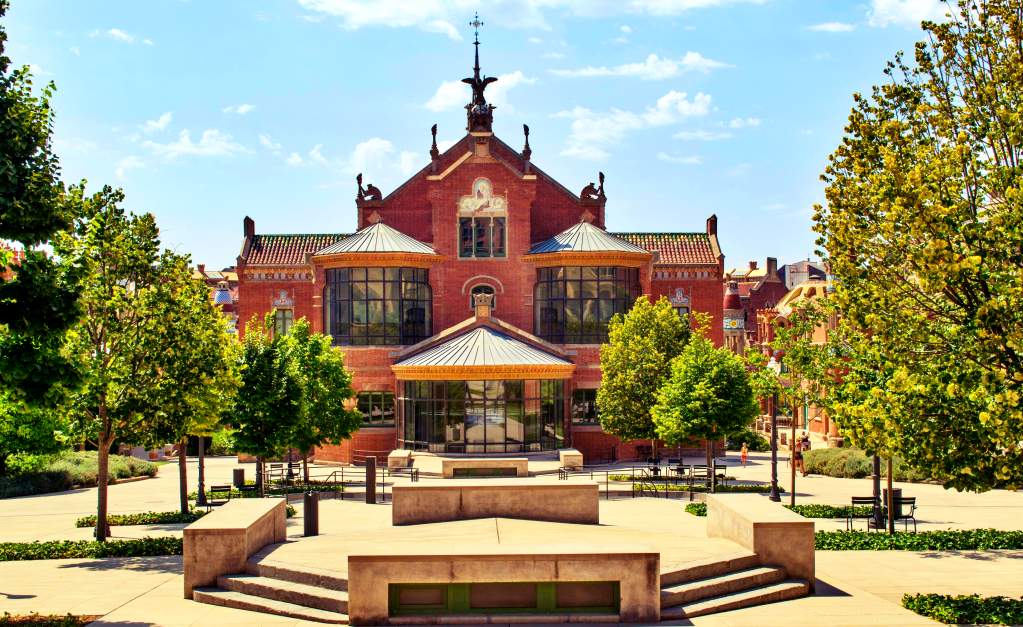
Picture this: you are walking through Barcelona, coffee in hand, navigating past swarms of tourists taking selfies in front of the Sagrada Família. You walk down a pleasant, tree-lined pedestrian boulevard for about ten minutes, turn a corner, and suddenly—bam! You are standing in front of what appears to be a fairy-tale royal palace, overflowing with red brick, intricate mosaics, colorful ceramic domes, and lush gardens.
You check your map. Did you accidentally cross a portal into a fantasy novel?
Nope. You’ve just arrived at the Recinte Modernista de Sant Pau—which, believe it or not, was a fully functioning public hospital for nearly a century. If your idea of a hospital is neon lights, linoleum floors, and the faint smell of despair, Sant Pau is here to completely redefine your medical expectations.
The backstory: A banker’s last will and testament
To understand how this architectural miracle came to be, we have to rewind to late 19th-century Barcelona. At the time, the city’s primary medical facility was the medieval Hospital de la Santa Creu, located in the cramped, gloomy neighborhood of El Raval. It was overcrowded, outdated, and desperately in need of an upgrade.
Enter Pau Gil, a wealthy Catalan banker living in Paris. When Gil passed away in 1896, his will contained a rather specific instruction: a huge chunk of his fortune was to be used to build a brand-new, state-of-the-art hospital in Barcelona. There were just two main conditions:
-
It had to be cutting-edge in terms of health and hygiene.
-
It had to be named after Saint Paul (Sant Pau).
The city combined Gil’s bequest with the existing Santa Creu organization, giving birth to the formal name: Hospital de la Santa Creu i Sant Pau.
The mastermind: Lluís Domènech i Montaner
Who do you call when you want to build a revolutionary, beautiful hospital? In 1901, the job went to Lluís Domènech i Montaner.
If Antoni Gaudí is the undisputed king of Catalan Modernisme (Art Nouveau), Domènech i Montaner is the brilliant, highly sophisticated prince who arguably had better organizational skills. Domènech wasn’t just an architect; he was a true Renaissance man—a politician, publisher, professor, and historian. In fact, he was actually Gaudí’s professor at the Barcelona School of Architecture!
Domènech believed in a radical idea for the early 1900s: beauty heals.
He theorized that patients would recover faster if they were surrounded by natural light, fresh air, art, and nature, rather than sterile white walls. Rather than constructing one giant, depressing skyscraper of illness, he designed a mini-city of 28 independent pavilions nestled inside landscaped gardens.
“Architecture has a therapeutic value. A pleasant environment, surrounded by nature and beauty, gives peace of mind to the sick and accelerates their recovery.” — Lluís Domènech i Montaner (philosophical summary)
Domènech dedicated the later years of his life to this masterpiece. When he passed away in 1923, his son, Pere Domènech i Roura, took over the reins, finishing the main complex for its official opening in 1930 by King Alfonso XIII.

Architecture: Mosaics, Tunnels, and Sunbeams
Walking through Sant Pau feels like strolling through an open-air art museum. Domènech i Montaner blended traditional Catalan building techniques—like the famous Catalan vault (volta catalana)—with Gothic revival elements and a burst of Modernista exuberance.
Here are a few architectural flexes that make Sant Pau so special:
-
The angle of light: Domènech deliberately aligned the complex at a 45-degree angle compared to the standard grid of Barcelona’s Eixample district. Why? To catch as much daily sunlight as humanly possible and to capture the fresh sea breeze for natural ventilation.
-
The underground secret: To keep the surface gardens serene and free of clutter, the architect built over a kilometer of underground tunnels connecting all the pavilions. Doctors, supplies, food, and even patient stretchers moved quietly beneath the ground, leaving the sunny gardens above dedicated purely to patient relaxation.
-
Color therapy: The roofs are covered in glazed ceramic tiles that glisten in the Mediterranean sun like dragon scales. Inside the pavilions, the walls feature delicate floral patterns, soft pastel tiles, and stained glass windows that filter sunlight into soothing colors.
Sant Pau vs. Gaudí: A friendly rivalry
It is impossible to talk about Sant Pau without mentioning Barcelona’s favorite son, Antoni Gaudí.
The two architectural giants had mutual respect for one another, though their styles were distinct.
While Gaudí leaned heavily into organic, wild, free-flowing shapes inspired by nature (think: tree trunk columns and bone-like structures), Domènech i Montaner’s work was more structured, monumental, and packed with historical symbolism and exquisite decorative craftsmanship.
Fun fact: The two icons are physically linked in the city layout! Avinguda de Gaudí is a grand pedestrian street built specifically to connect Domènech’s Sant Pau Hospital directly with Gaudí’s Sagrada Família. It’s a literal pathway between two Modernista geniuses.
Hospital life: Getting sick in style
It’s easy to forget while admiring the stained-glass windows that Sant Pau wasn’t built as a tourist attraction—it was a real, working public hospital. And it remained one until 2009, when modern medical needs finally outgrew the historic pavilions, moving operations to a modern building nearby.
Imagine being a resident of Barcelona in the mid-20th century:
-
Categorized by Care: Men and women were housed in separate pavilions on opposite sides of the central avenue (labeled with statues of male and female saints, respectively).
-
Infectious Wards: Patients with contagious illnesses were isolated in pavilions located downwind to prevent airborne germs from spreading to others.
-
Surgical Glamour: The operating theater features massive panoramic windows facing north, providing surgeons with steady, shadowless daylight throughout the day. Getting your appendix removed under an Art Nouveau dome is certainly one way to go under the knife!
For over eight decades, generations of Barcelonans were born, treated, and cured inside these fairy-tale pavilions.
Visiting Sant Pau today
Declared a UNESCO World Heritage Site in 1997, the restored complex is now open to visitors, hosting cultural institutions, exhibitions, and peaceful strolls.
If you are planning a trip to Barcelona, put Sant Pau at the top of your list. While thousands of tourists elbow each other for space at other major landmarks, Sant Pau offers a surprisingly peaceful, awe-inspiring experience where you can truly appreciate the genius of Catalan Modernisme.
It turns out that a century ago, an architect figured out what modern healthcare is only now rediscovering: a little bit of sunshine, a splash of art, and a breath of fresh air can do wonders for the human soul.
Curious to explore the stories behind the stones?
Sant Pau has a thousand secrets waiting to be discovered. Take your visit to the next level with an exclusive 4-hour author tour—a tailor-made, immersive journey crafted specifically for travelers who love detail, history, and authentic storytelling.