
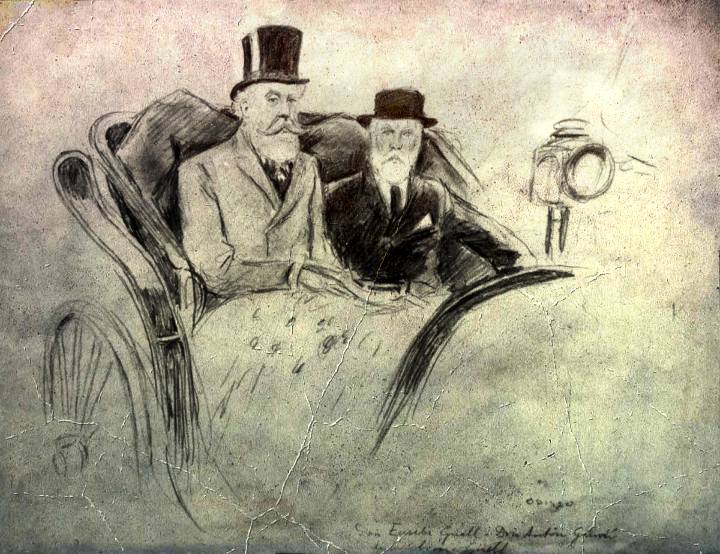
Barcelona is a city defined by its architecture, a place where stone turns into waves and columns mimic the trunks of ancient trees. But the breathtaking landscape we see today wasn’t the work of just one man. It was the result of one of the most successful, ambitious, and deeply trusting partnerships in art history: the tandem of Eusebi Güell and Antoni Gaudí.
If Gaudí was the architectural genius who reached for the stars, Güell was the launchpad, the funding, and the kindred spirit who made it all possible. Without Güell’s immense wealth and unwavering faith, Gaudí’s wildest dreams might have remained trapped in his sketchbooks.
Here is the story of how a wealthy industrialist and a son of a coppersmith joined forces to change Barcelona forever.
Two paths, one shared vision
To understand their connection, we first have to look at who these men were before their worlds collided.
Eusebi Güell: The enlightened industrialist
Born in 1846, Eusebi Güell i Bacigalupi was the epitome of the 19th-century Catalan bourgeoisie—but with a twist.
He wasn’t just interested in factories and profits. Güell was a highly educated man, a lover of the arts, philosophy, and sciences.
He traveled extensively throughout Europe, returning to Catalonia with a desire to modernize his homeland not just economically, but culturally.
This is the reason why he needed an artist who could match his grand ambitions and give physical form to his progressive ideas.

Antoni Gaudí: The mystical genius
Born in 1852 in Reus, Antoni Gaudí i Cornet came from a humble background of craftsmen.
This upbringing gave him a profound, three-dimensional understanding of space and materials. Gaudí was proud, deeply religious, intensely observant of nature, and fiercely independent.
When he graduated from the Barcelona Higher School of Architecture in 1878, the director famously stated: “We have given this academic title either to a fool or a genius. Time will tell.”
The spark: A chance encounter in Paris
Time did not take long to tell. The historic meeting between the two men happened in 1878, the very year Gaudí graduated.
Gaudí had designed a striking, innovative showcase for a glove shop (Guanteria Comella) to be displayed at the Paris Universal Exposition. Eusebi Güell, visiting the expo, was utterly captivated by the originality of the display. He was so impressed that upon returning to Barcelona, he immediately sought out the young architect.
The chemistry was instant. Güell didn’t just see a talented architect; he saw a visionary. Gaudí didn’t just see a client; he found a patron who didn’t want him to hold back. From that moment on, their relationship transcended a simple business arrangement; it became a lifelong friendship based on mutual admiration and absolute creative freedom.

The masterpieces: Palau Güell and Park Güell
While their collaborations spanned many projects—including the Güell Pavilions and the crypt of the Colònia Güell—their relationship peaked with two monumental projects that define Barcelona’s identity: Palau Güell and Park Güell.
Palau Güell: The Mansion of Modernity (1886–1890)
Located just off the bustling La Rambla, Palau Güell was Gaudí’s first major commission for his patron. Güell wanted an urban palace that could host high-society events, concerts, and political gatherings.
Gaudí threw himself into the project, using a massive budget to create a building that feels part medieval fortress, part Venetian palace, and part futuristic dream.
-
The Magic of Light: Gaudí designed a magnificent central hall with a parabolic dome that acts as a planetarium, letting in natural light through small openings to mimic stars at night.
-
The Rooftop Revolution: It is here, on the roof of Palau Güell, that Gaudí first experimented with his famous trencadís (broken ceramic mosaic) technique, turning twenty functional chimneys into vibrant, colorful sculptures.
For Güell, the palace was a roaring success. It cemented his status as Barcelona’s ultimate trendsetter.
Park Güell: The dream of a utopian garden city (1900–1914)
A decade later, Güell’s ambitions expanded from a single mansion to an entire neighborhood. Inspired by the English “Garden City” movement, Güell purchased a rocky, barren hill overlooking the Mediterranean (known as the Muntanya Pelada) and tasked Gaudí with designing an exclusive, gated residential estate for sixty luxury homes.
Financially, the project was a failure; Barcelona’s elite found the location too remote at the time, and only two houses were ever built. However, artistically, it became Gaudí’s ultimate playground.
Gaudí refused to flatten the mountain. Instead, he integrated his architecture into the landscape. He designed viaducts that look like petrified trees, a massive hypostyle hall supported by 86 Doric columns, and the famous undulating bench that frames the most iconic view of Barcelona. Park Güell became a testament to what happens when an architect is allowed to let nature be his only blueprint.
The end of an Era
Eusebi Güell passed away in 1918 at his home—which was, fittingly, inside Park Güell. After his death, his heirs offered the park to the Barcelona City Council, and it opened as a public park in 1926.
Losing his greatest friend and supporter deeply affected Gaudí. In his later years, the architect withdrew from social life, moving into the Sagrada Família workshops and dedicating himself entirely to his religious masterpiece until his tragic death in 1926.
Without Güell, we would not have the Gaudí we know today. Their tandem proved that great art requires not just a brilliant mind to create it, but an open mind to believe in it.
5 reasons to visit Park Güell and Palau Güell
If you want to truly understand the soul of Barcelona, walking through these two monuments is non-negotiable. Here are five reasons why you need to book your tour today:
1. Experience the full evolution of Gaudí’s genius
By visiting both sites, you witness the incredible transformation of an artist. You can contrast the dark, moody, gothic-inspired luxury of Palau Güell (his early masterpiece) with the explosive, colorful, nature-worshiping freedom of Park Güell (his mature style).
2. Stand on the world’s first Modernist rooftops
Gaudí believed that rooftops shouldn’t be ugly storage spaces. At Palau Güell, you can wander through a forest of magical, whimsical chimneys. At Park Güell, you can sit on the famous serpentine bench, completely covered in vibrant trencadís mosaics, offering the ultimate panoramic view of the Mediterranean.
3. Step inside the real lives of Barcelona’s elite
This isn’t just about looking at pretty buildings; it’s about history. Walking through Palau Güell allows you to see how the wealthiest man in Barcelona lived, threw parties, and entertained high society. It is a time capsule of Catalonia’s Golden Age.
4. Marvel at architecture inspired entirely by nature
In Park Güell, you will see how Gaudí defied traditional engineering. There are no straight lines because there are no straight lines in nature. You will walk under stone waves, marvel at columns that look like palm trees, and see how architecture can perfectly blend into the natural environment.
5. Discover the stories behind the stones
Every corner of these monuments holds a secret, from the hidden acoustics in Palau Güell’s concert hall to the mythological symbols tucked away in Park Güell’s fountains. Joining our expert-led tour ensures you won’t just look at the beauty—you will actually understand the fascinating stories, coded symbols, and friendship that built them.
Skip the crowds and unlock the symbols.
Seeing Gaudí is great, but understanding Gaudí changes everything. Let our expert local guides show you the untold stories behind these two masterpieces on a fully customized private tour.