
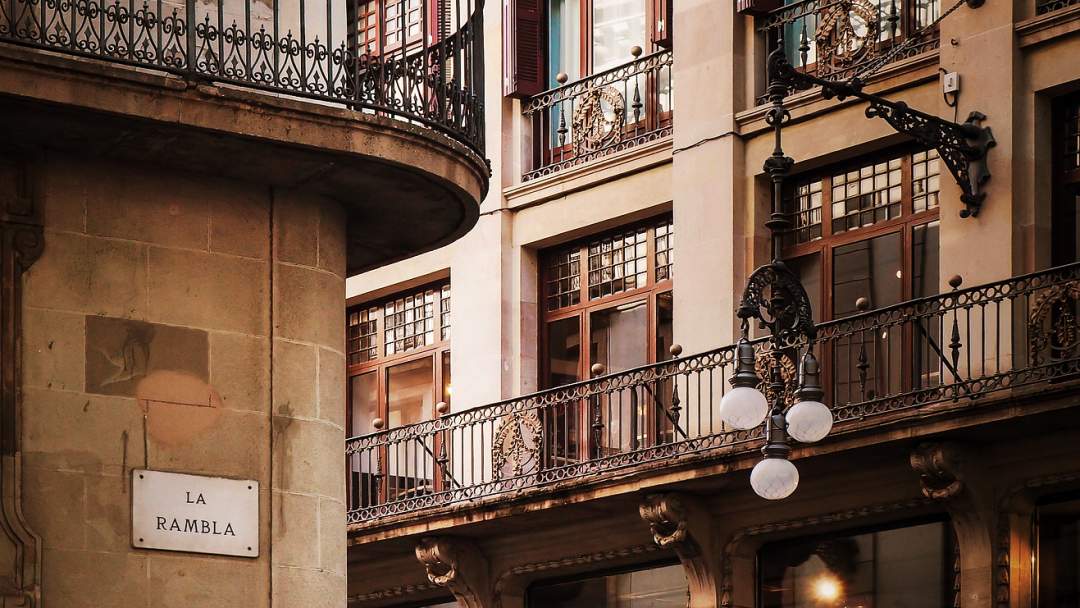
If you stand at the top of La Rambla today, you aren’t just looking at a boulevard; you’re looking at a transformation in progress.
In 2026, La Rambla is undergoing its most significant renovation in over a century. This isn’t just a “facelift”—it is a reclamation. Barcelona is taking its most famous artery and breathing new life into it, turning a space often dominated by tourism back into a “long and flexible forum” where diversity can take a stroll.
From the mountains to the sea, La Rambla has always been a modern Babylon. But to understand where it’s going, we have to look at where the water used to flow.
From a Muddy River to a High-Society Stage
It’s hard to imagine, but in the 13th century, La Rambla wasn’t a place for people; it was a place for water. The name itself comes from the Arabic word Ramla, meaning a sandy riverbed. It was a seasonal torrent that ran just outside the medieval city walls.
As the city grew, the water was diverted, and the “river” became a road. By the 16th and 17th centuries, the area was populated by cloisters and religious houses.
However, the real magic happened in the 19th century when the city walls were finally demolished. This was the Big Bang of modern Barcelona. Suddenly, the Ramblas became the “place to be.” Important buildings sprang up like mushrooms after a rainstorm: the Liceu Opera House, the Boqueria Market (St. Joseph’s Market), the Church of Betlem, and the hauntingly beautiful Palau Güell by Gaudí.
Would you like to know more abut it? or better, to experience it? Book one of hour private tours and be ready for an “wow” moment!

One Name, Five Personalities
While we call it “La Rambla,” locals often use the plural: Les Rambles. This is because the boulevard is actually a sequence of five distinct sections, each with its own flavor:
Rambla de Canaletes: Home to the famous Canaletes Fountain. Legend says that if you drink its water, you are destined to return to Barcelona. (Consider it a liquid contract with the city).
Rambla dels Estudis: Historically known for the university that once stood here.
Rambla de Sant Josep (The Flower Rambla): The only place in the 19th century where you could buy flowers in the city—and still the most fragrant part of the walk.
Rambla dels Caputxins: Where the social heart beats, home to the Liceu and the nearby Plaça Reial.
Rambla de Santa Mònica: The final stretch that leads you to the sea and the Columbus Monument.
The Green Lungs: A History of Trees
The trees of La Rambla are as much a part of the architecture as the stone buildings. They have been there since the beginning. In 1702, the city planted 280 birch trees, which were later replaced by elms. In 1832, acacias were tried, but they weren’t quite right for the Mediterranean soul of the street.
Finally, in 1859, the Platanus (Plane trees) were planted. These are the giants we see today, providing a thick canopy of shade that protects walkers from the scorching Catalan sun. They are the silent witnesses to centuries of protests, parades, and parties.
The flower stalls: romance, secrets, and celebrity
If the trees are the lungs, the flower stalls are the heart. These stalls have resisted time, fashion, and politics. One of the most legendary is Flores Carolina, currently managed by Carolina Pallés. She represents the fifth generation of a family that has seen it all.
The client list for these florists reads like a “Who’s Who” of the 20th century. Salvador Dalí was a regular, as was the musician Xavier Cugat. The great poet Federico García Lorca was so enchanted by the florists that he became a fixture of the street.
The florists also held the city’s secrets. In the old days, high-society men would often buy two identical bouquets: one for the wife, and one for the mistress. The florists, ever the professionals, never swapped the cards! This rich culture inspired artists like Ramon Casas and Utrillo, and it lives on in the song “La Florista de la Rambla” by Miquel Porter, famously performed by Joan Manuel Serrat.

The legend of the secret admirer
Speaking of Lorca, there is a beautiful story from December 1935. The legendary actress Margarita Xirgu was performing at the Liceu. Every day, a bouquet would arrive for her—no card, no name.
When she eventually discovered the “secret admirers” were actually the flower sellers of La Rambla, she was deeply moved. Lorca and Xirgu decided to dedicate a special performance of their play to these women, honoring the “Queens of the Rambla” who filled the street with color even in the darkest times.
The 2026 transformation: What’s new?
As we walk through 2026, we are witnessing the “New Rambla.” The renovation is a massive project designed to make the street more pedestrian-friendly and green.
-
More Space for People: The sidewalks are being widened, and the “traffic” is being pushed to the periphery to allow the central promenade to breathe.
-
Cultural Reconnection: The renovation aims to reconnect the Gothic Quarter with the Raval, making it easier to slip into the side streets to discover hidden gems.
-
The 2012 Legacy: The flower stalls continue their “makeover” journey. Back in 2012, the Massana Art School collaborated to give the stalls a botanical spirit, using vinyl art representing roses and begonias. Today, that artistic spirit is being integrated into the permanent structure of the new boulevard.
La Rambla, a modern Babylon
Today, La Rambla remains an interclass spot. You’ll see a street performer next to a billionaire, a local grandfather sitting on a rental chair next to a student from halfway across the world. It is a place where “diversity goes for a walk.”
Even with the construction noise of 2026, the smell of the roses at Flores Carolina and the sound of the Canaletes Fountain remain. Barcelona is a city that knows how to reinvent itself without losing its soul. La Rambla is the proof.

See the Transformation of Barcelona Firsthand
Reading about La Rambla is one thing, but smelling the roses at Flores Carolina and hearing the echoes of the Opera House with a local by your side is another. Join me for a Private Tour of the Gothic Quarter and La Rambla, where we’ll navigate the 2026 renovations together, uncover hidden medieval corners, and see the city through the eyes of the artists who loved it.